Kolkata Decoded (Part 2 – 1/2): Understanding the Core Structure of Kolkata
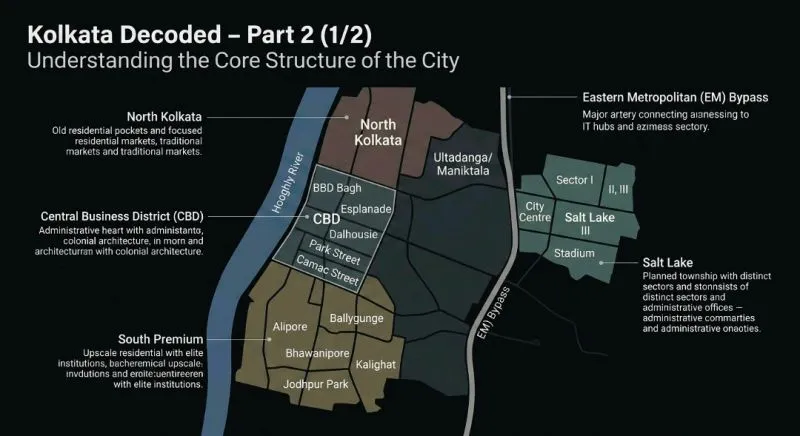
Before diving into metro corridors and infrastructure-led growth, one thing needs to be clearly understood:
Kolkata is not a single, uniform real estate market.
It is a network of distinct economic zones, each operating with its own pricing logic, demand drivers, and development patterns.
For investors, homebuyers, and especially NRIs evaluating opportunities in the city, this foundational understanding is critical.
In this part of the Kolkata Decoded series, we break down the core structural zones that define the city’s real estate ecosystem today.
1. Central Business Core (CBD)
📍 Esplanade | BBD Bagh | Dalhousie | Park Street | Camac Street
Function:
- Administrative and financial headquarters of Eastern India
- Legacy commercial buildings
- High institutional occupancy
- Limited new Grade A supply
This is heritage commercial Kolkata.
It is characterised by high density, high activity, and a supply-constrained environment, where demand continues to be driven by institutional and legacy occupiers.
2. North Kolkata
📍 Shyambazar | Sovabazar | Maniktala | Dum Dum
Function:
- Old residential clusters
- Traditional business communities
- Strong rail and arterial connectivity
This region represents stable, end-user-driven demand.
Development is largely constrained by limited vertical redevelopment, preserving the character of traditional neighbourhoods.
3. South Kolkata (Established Premium Belt)
📍 Ballygunge | Alipore | Bhawanipore | Kalighat | Jodhpur Park
Function:
- Premium residential market
- Presence of cultural and educational institutions
- Low-rise, scarcity-driven supply
This is legacy premium Kolkata.
Property prices in this belt tend to move gradually, but rarely see sharp corrections, driven by limited supply and sustained demand.
4. EM Bypass Urban Spine
📍 Science City | Ruby | Anandapur | Mukundapur
Function:
- Hospital and hospitality corridor
- Mixed-use residential development
- Key arterial connectivity reducing city congestion
The EM Bypass has evolved into modern Kolkata’s primary growth axis.
It plays a crucial role in shaping new-age residential and commercial demand, supported by infrastructure and accessibility.
5. Salt Lake (Bidhannagar)
📍 Sector I, II, III | City Centre | Stadium
Function:
- Planned township
- Government and institutional presence
- Mature residential-commercial mix
Salt Lake stands out for its structured urban planning, which leads to predictable and stable demand patterns across both residential and commercial segments.
What Comes Next
This is Part 1 of Part 2 in the Kolkata Decoded series.
In the next part, we will decode:
- South-West Growth Corridor (New Alipore, Behala, Joka)
- Garia–Patuli–New Garia belt
- Sector V as the IT and employment engine
- New Town & Rajarhat expansion
- Airport corridor
- Howrah — Eastern India’s transport powerhouse
Because in Kolkata’s real estate market,
every zone has its own story — and every investor needs to understand it.
About the Series
Kolkata Decoded is a weekly series on Kolkata Calling by Deep Sarkar, Strategic Real Estate Advisor, who brings a data-backed, analytical approach to understanding the city’s property market. The series is contributed pro-bono through Deep Properties, with the aim of delivering transparent, fact-based insights to the community.