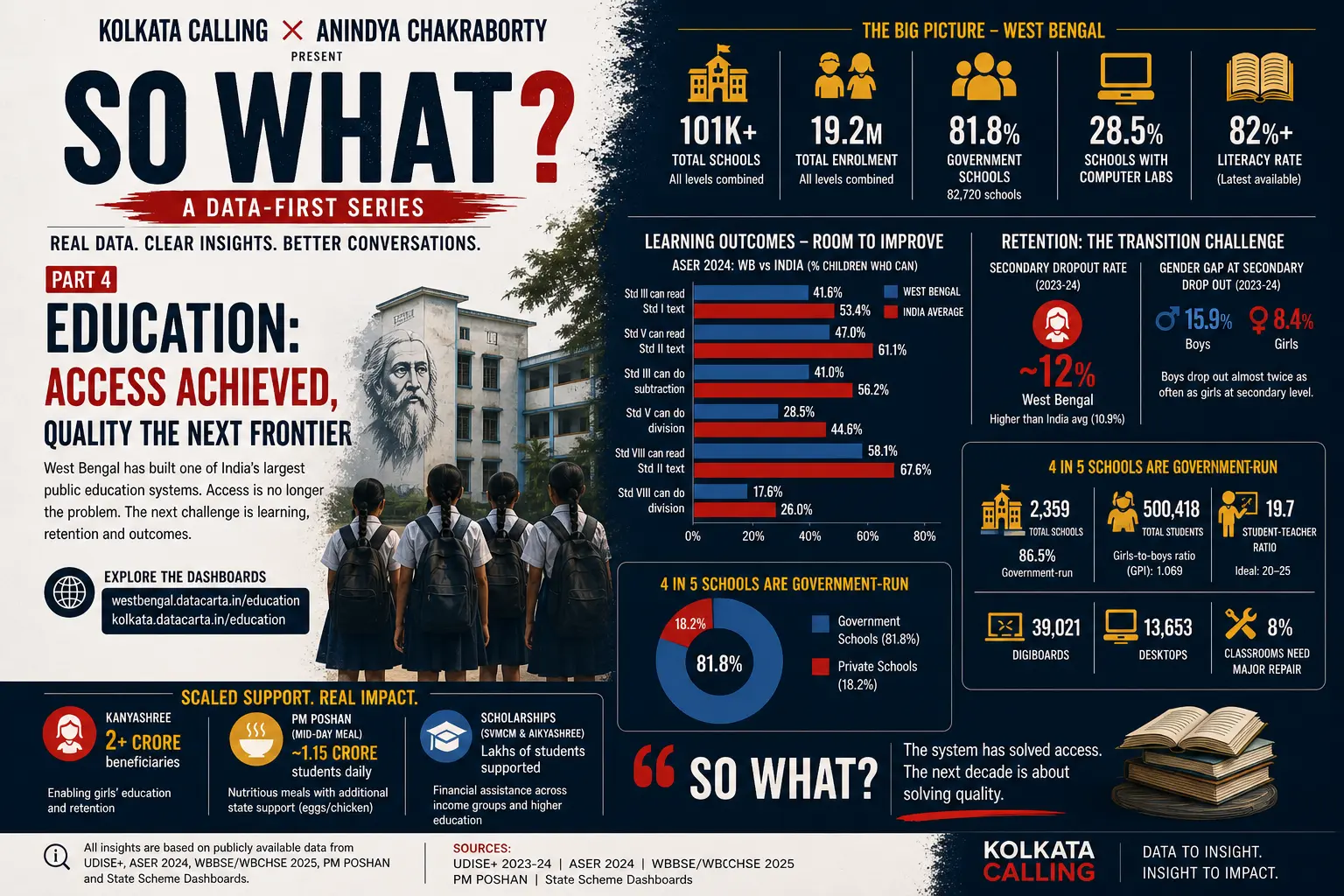
SO WHAT? – PART 4 Education: Access Achieved, Quality the Next Frontier
A data-driven look at education in West Bengal and Kolkata—exploring access, infrastructure, learning outcomes, and why the next phase of progress depends on improving quality.
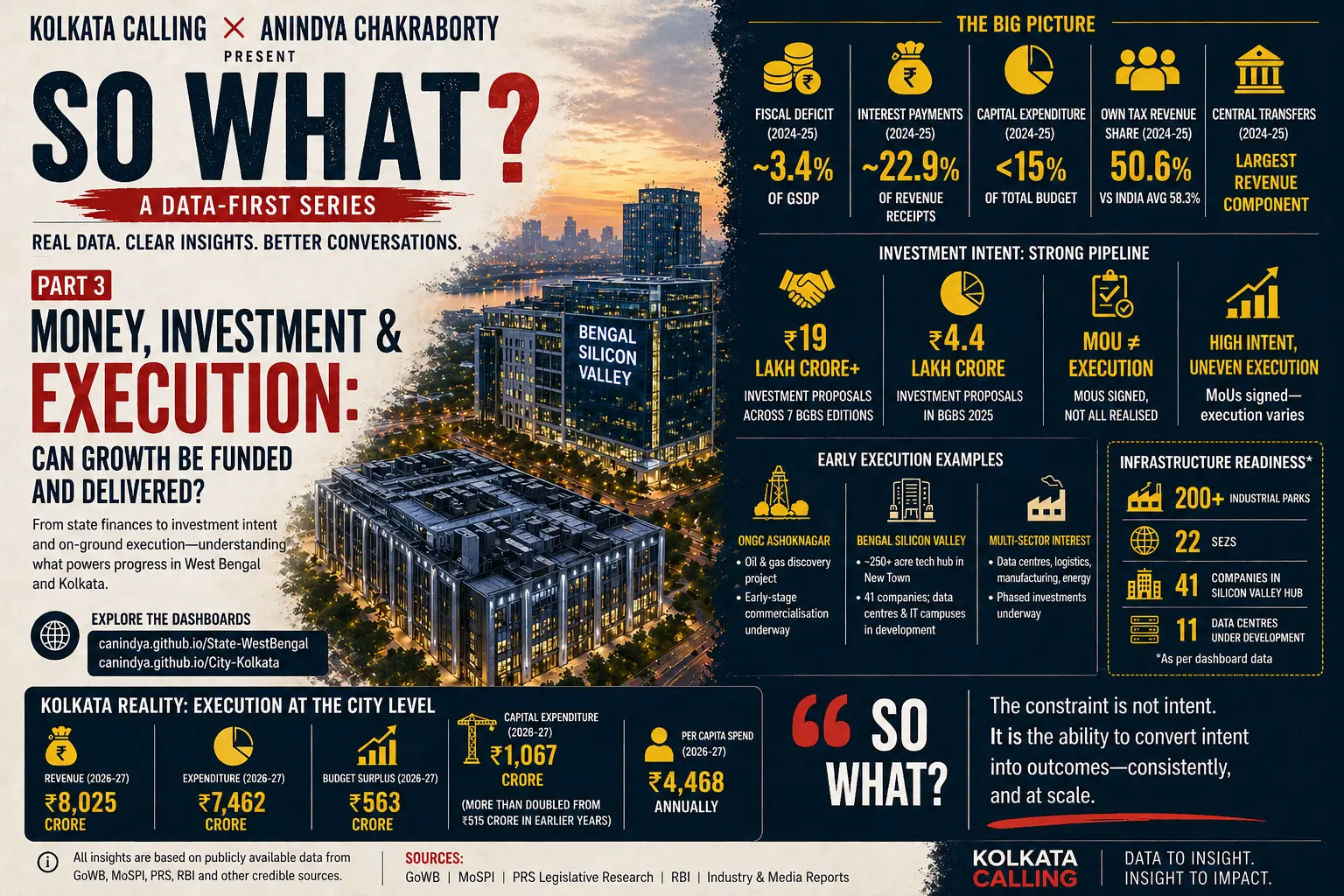
A data-driven analysis of West Bengal’s finances, investment pipeline, and execution capacity—exploring how fiscal constraints and project delivery shape long-term growth.
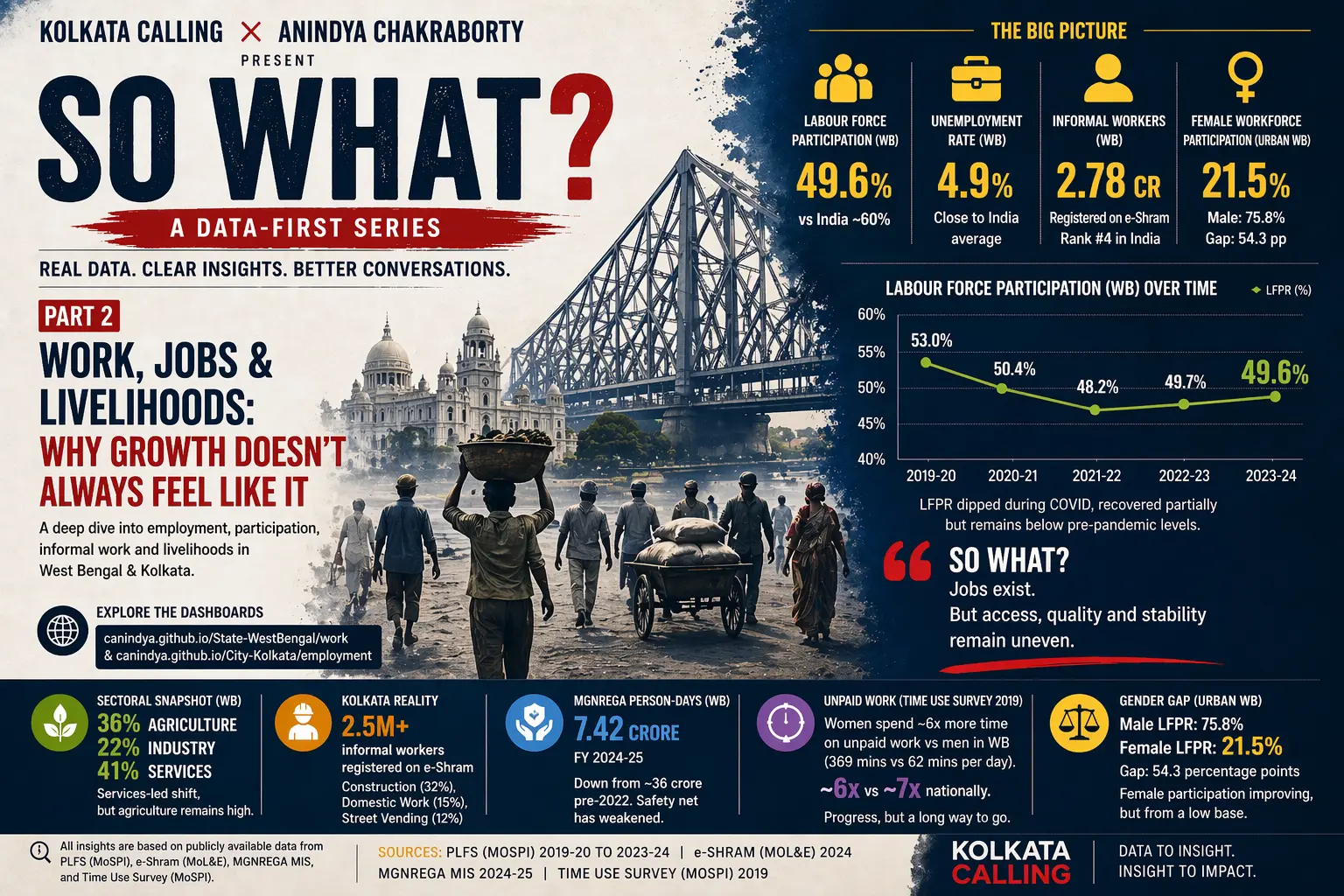
A data-driven analysis of jobs and livelihoods in West Bengal and Kolkata—exploring labour participation, informal work, gender gaps, and why growth does not always translate into broad-based opportunity.
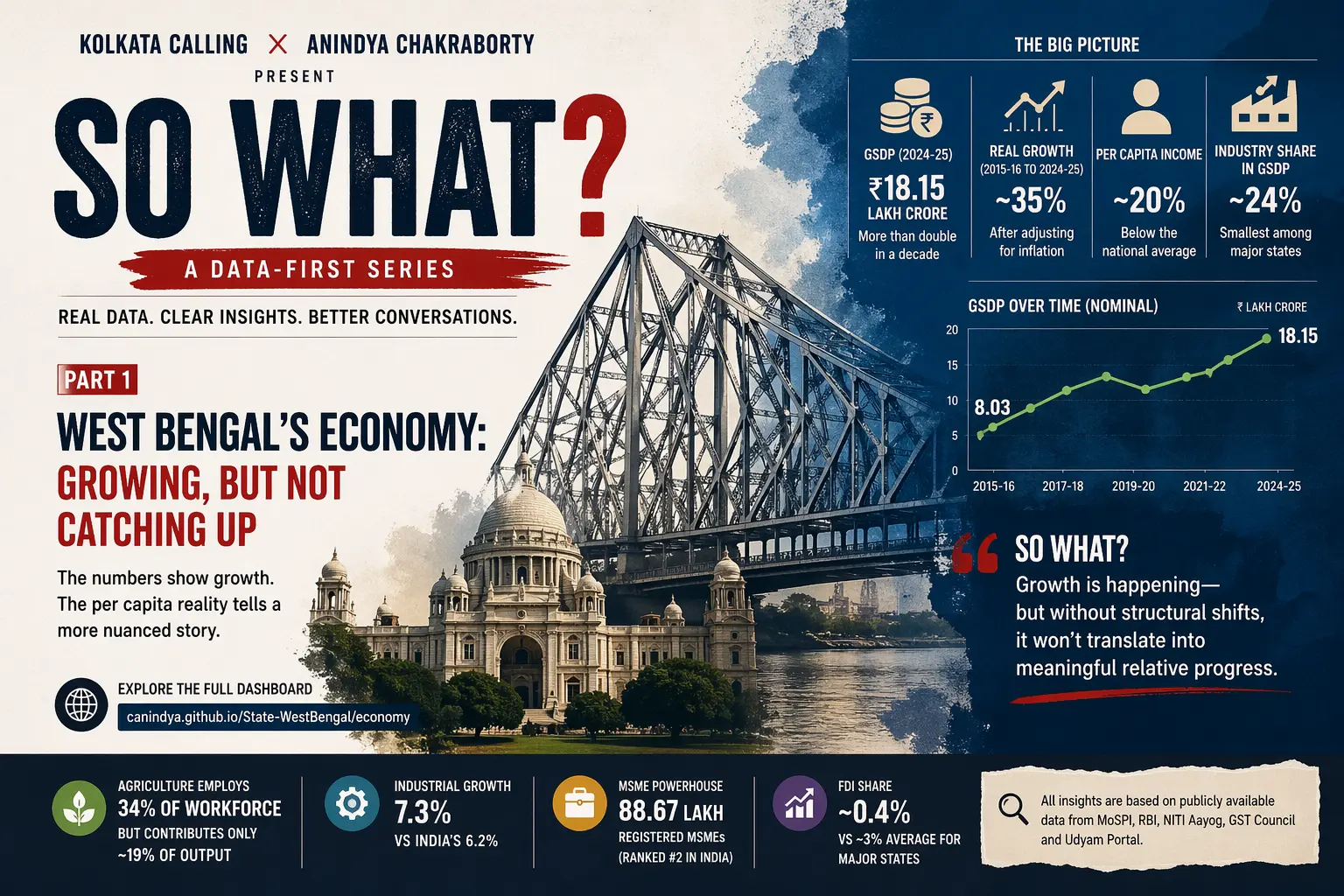
A data-driven look at West Bengal’s economy—its growth, structural challenges, and why it is not yet catching up with faster-growing states, based on publicly available data and real on-ground developments.
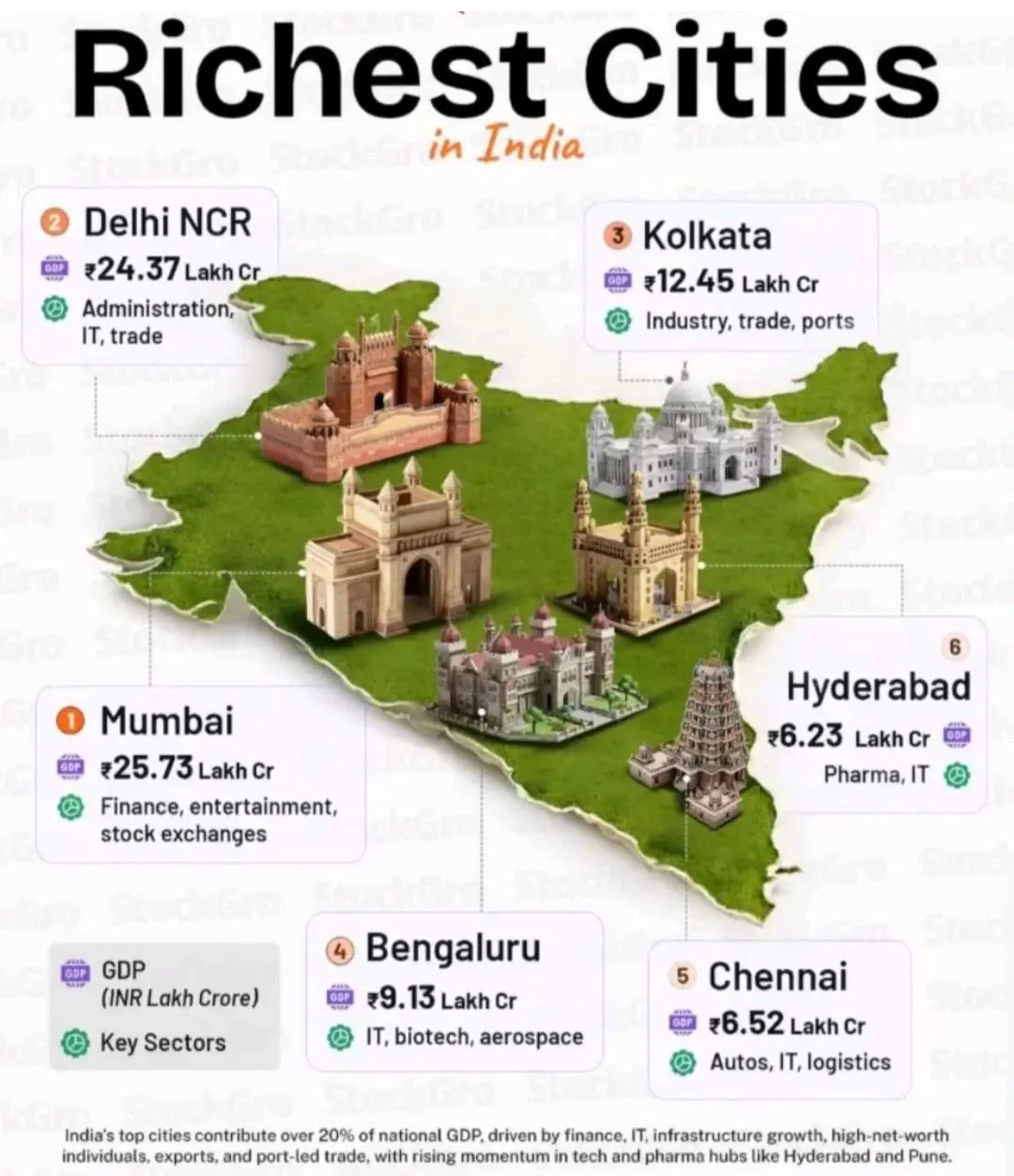
A closer look at why Kolkata ranks as India’s 3rd richest city, exploring its diversified economy, logistics advantage, MSME strength, and consumption-driven growth model.
As West Bengal heads into the 2026 elections, the Tajpur Deep Sea Port emerges as the most consequential economic decision of the decade. This opinion piece examines how Tajpur could redefine Bengal’s logistics, manufacturing, export ecosystem, and geopolitical relevance for generations to come.
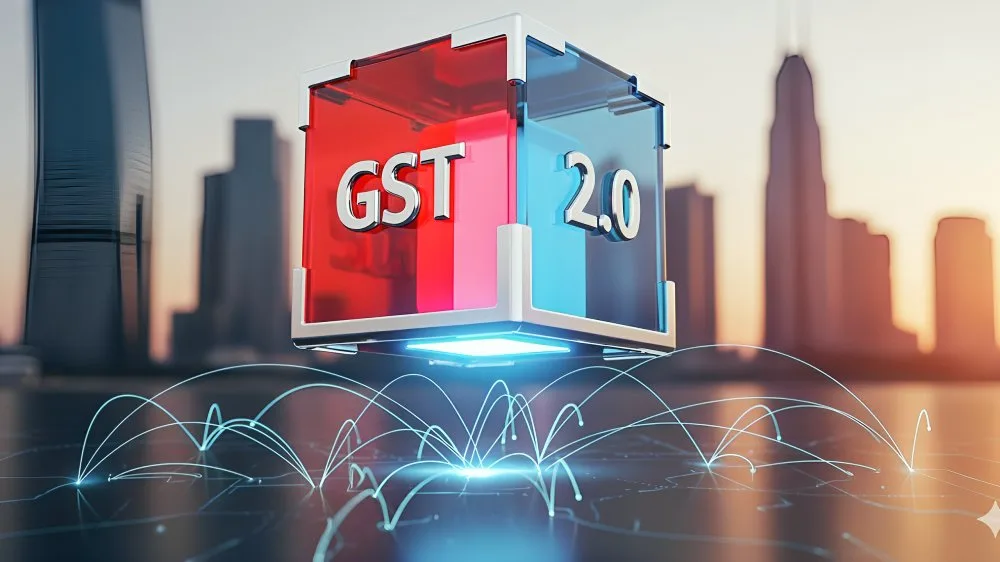
The GST Council’s landmark move in September 2025 to simplify India’s taxation system popularly called GST 2.0, has brought a two-rate structure of 5% and 18%, with essentials exempted. Beyond easing compliance, this reform has opened up fresh opportunities for Bengal’s economy, impacting sectors that are deeply tied to its cultural identity, employment base, and global trade presence.
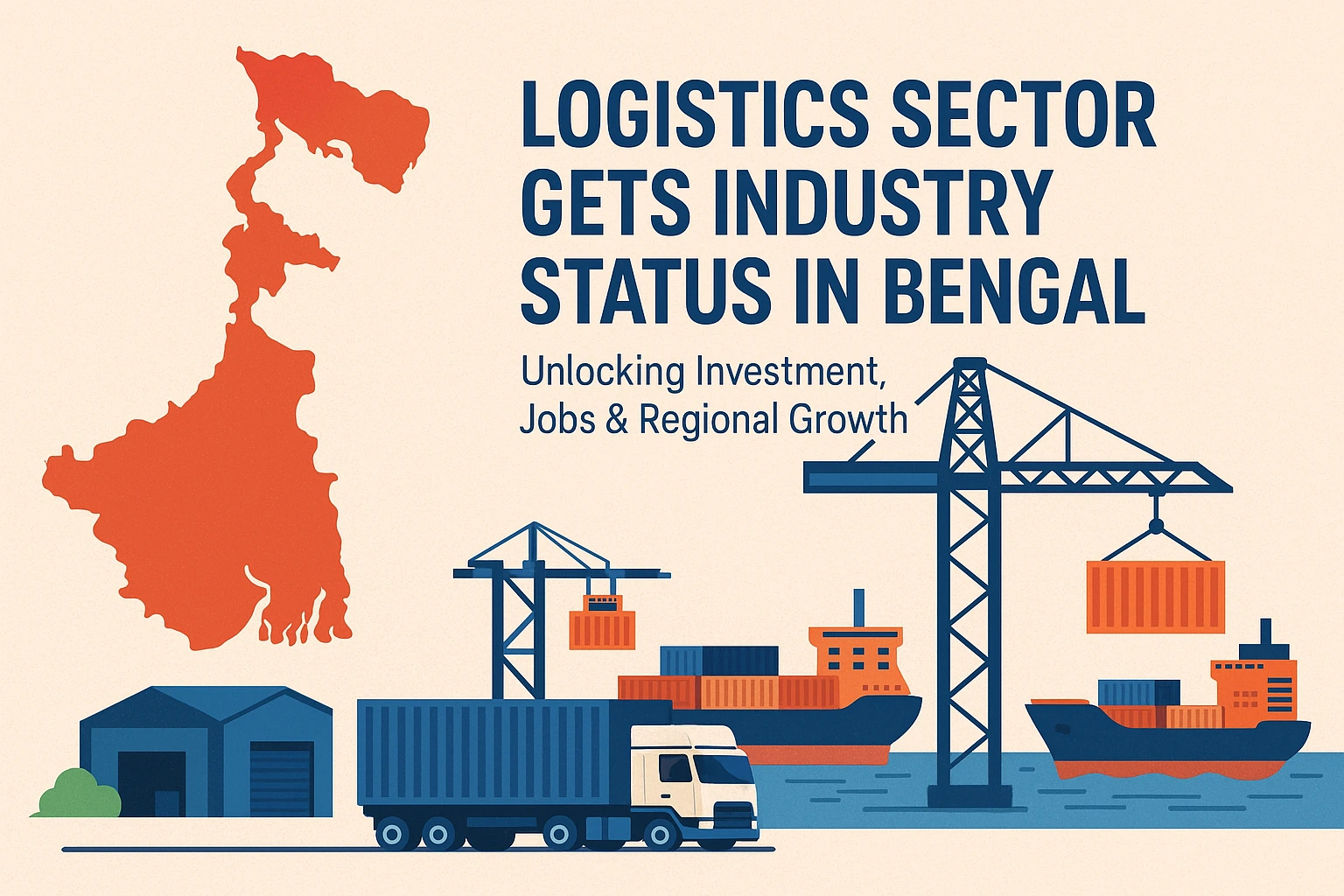
West Bengal grants industry status to logistics, paving the way for investments, jobs, and Bengal’s emergence as a logistics hub.
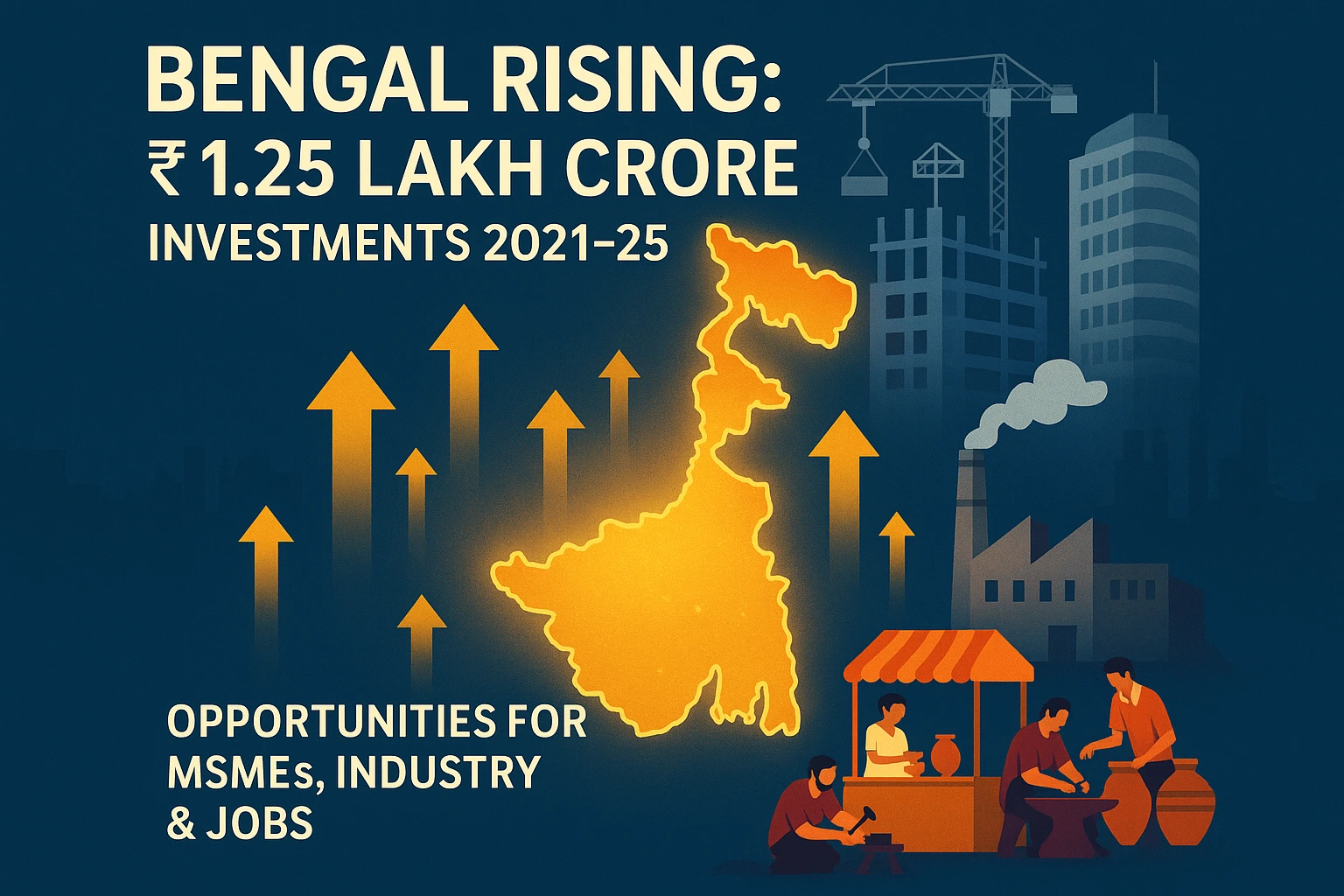
West Bengal has attracted nearly ₹1.25 lakh crore in investment between FY 2021-22 and FY 2024-25, driven by strong growth in IT, manufacturing, and infrastructure, according to a new study by the MSME Export Promotion Council, with data sourced from the CMIE. The investments are expected to generate over 75,000 new jobs. Read on for key insights and context.
Bengal is rapidly emerging as a logistics powerhouse with new warehousing hubs, upgraded transport corridors, and digital solutions transforming the state’s connectivity and trade landscape.
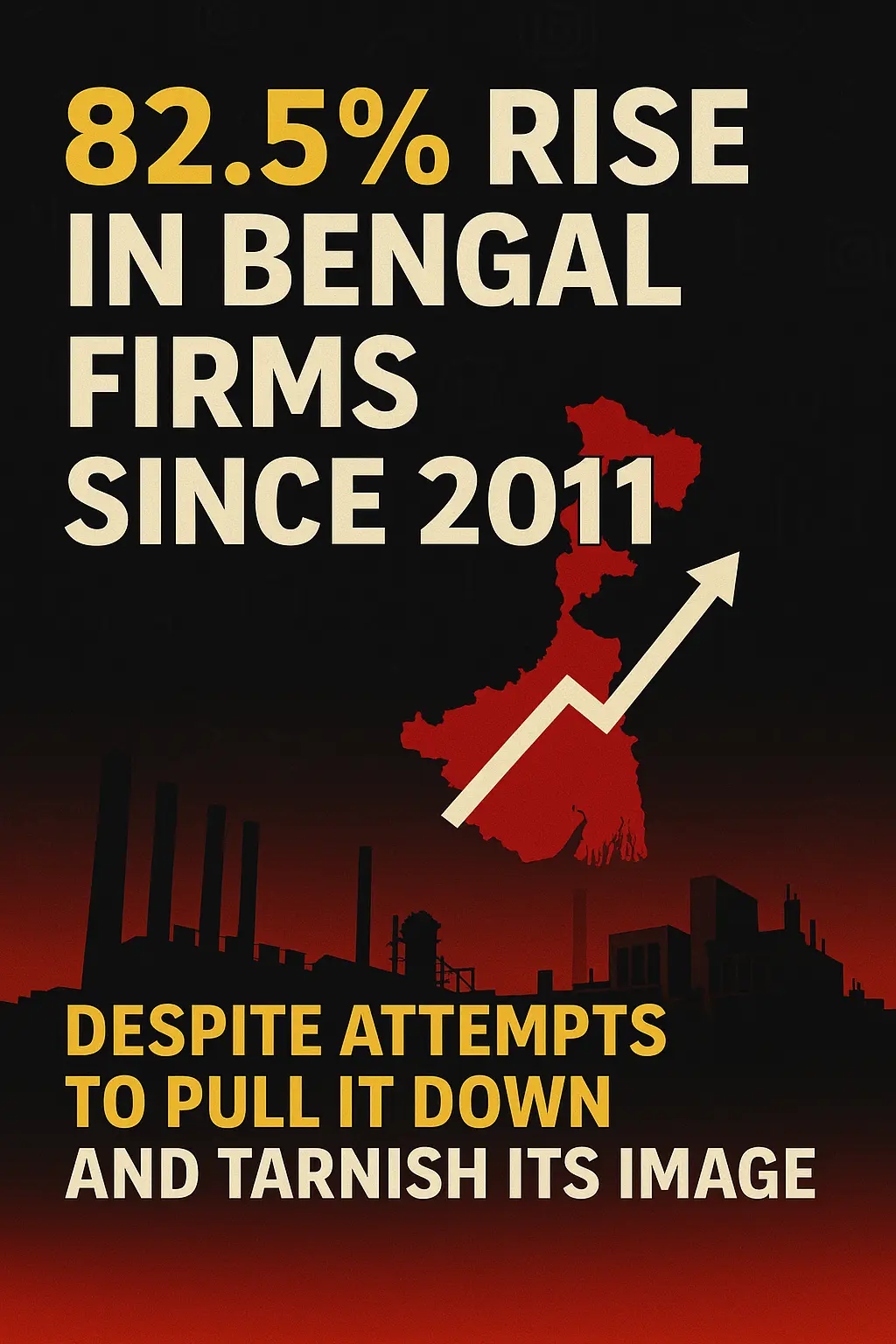
82.5% rise in Bengal firms since 2011, as per Union Ministry of Corporate Affairs data
A closer look at why Kolkata ranks as India’s 3rd richest city, exploring its diversified economy, logistics advantage, MSME strength, and consumption-driven growth model.
82.5% rise in Bengal firms since 2011, as per Union Ministry of Corporate Affairs data
As West Bengal heads into the 2026 elections, the Tajpur Deep Sea Port emerges as the most consequential economic decision of the decade. This opinion piece examines how Tajpur could redefine Bengal’s logistics, manufacturing, export ecosystem, and geopolitical relevance for generations to come.
Bengal is rapidly emerging as a logistics powerhouse with new warehousing hubs, upgraded transport corridors, and digital solutions transforming the state’s connectivity and trade landscape.
West Bengal has attracted nearly ₹1.25 lakh crore in investment between FY 2021-22 and FY 2024-25, driven by strong growth in IT, manufacturing, and infrastructure, according to a new study by the MSME Export Promotion Council, with data sourced from the CMIE. The investments are expected to generate over 75,000 new jobs. Read on for key insights and context.
A data-driven look at West Bengal’s economy—its growth, structural challenges, and why it is not yet catching up with faster-growing states, based on publicly available data and real on-ground developments.