SO WHAT? – PART 4 Education: Access Achieved, Quality the Next Frontier
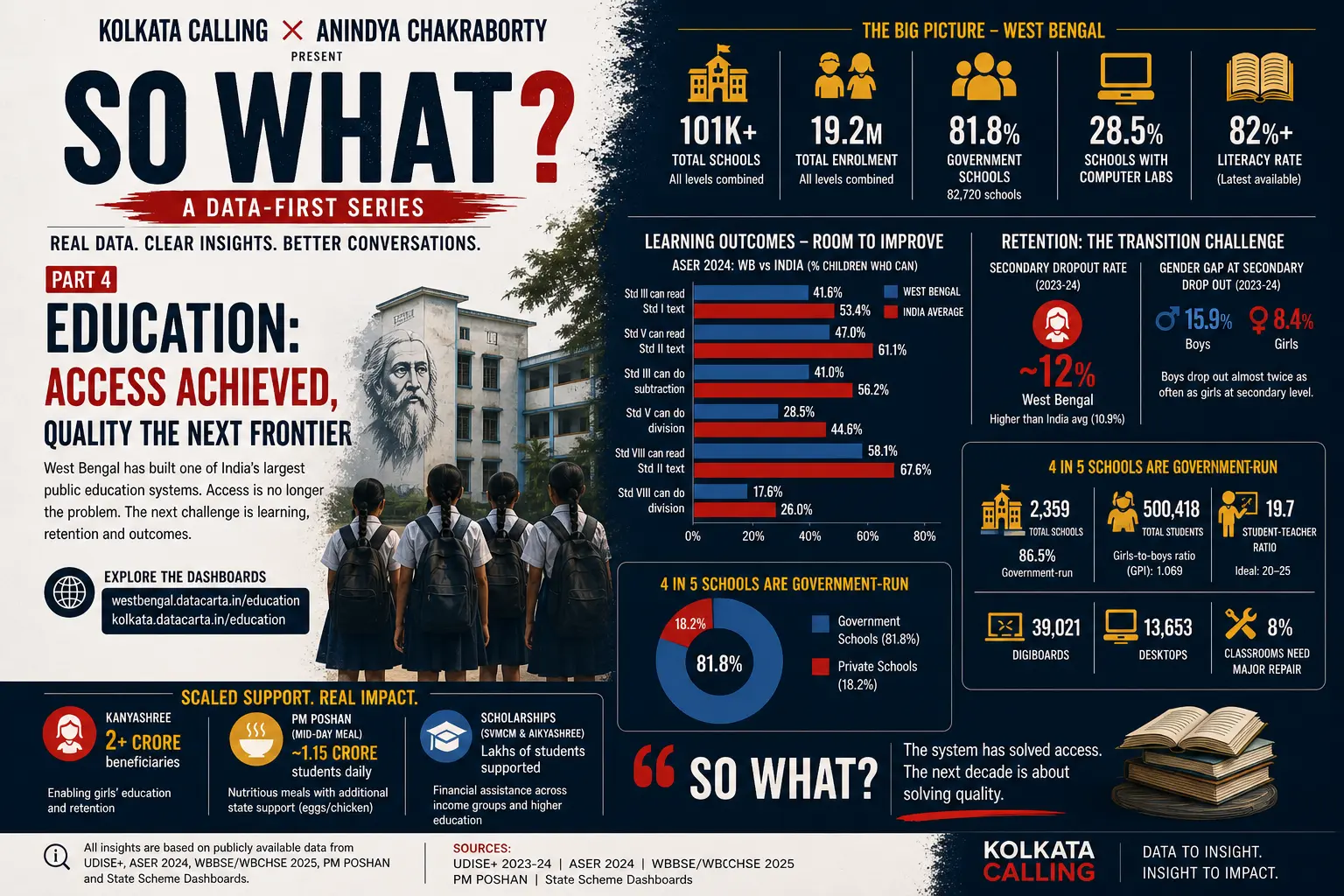
This is Part 4 of “So What?” — a data-first series by Kolkata Calling, built in collaboration with and based on the West Bengal & Kolkata dashboards compiled by Anindya Chakraborty.
In West Bengal, education is more than a system. It is part of the state’s identity.
From Rabindranath Tagore to Satyajit Ray, Bengal’s intellectual legacy has long shaped how the country thinks about learning, culture, and ideas. But beyond this legacy, the question today is simpler—and more urgent.
What does the data say about education in Bengal now?
A System Built for Access
At a state level, the scale of education in West Bengal is remarkable. With over 1.01 lakh schools serving nearly 1.92 crore students, the system reaches virtually every part of the state.
More importantly, access—historically the biggest barrier in education—has largely been addressed. The majority of schools are government-run, and basic infrastructure such as electricity, drinking water, and toilets is now close to universal. Literacy rates have crossed 82%, reinforcing the sense that schooling is no longer out of reach for most families.
This is not a small achievement. It represents decades of investment and policy focus.
But access, while necessary, is no longer the central challenge.
Kolkata: Strong Foundations, Subtle Gaps
Kolkata reflects the strengths of this system at a more concentrated level. The city has over 2,300 schools, with nearly 87% run by the government, and serves more than 5 lakh students across levels.
Classrooms are relatively well-staffed, with a student-teacher ratio of around 20, and gender parity has not just been achieved but slightly exceeded, with girls marginally outnumbering boys in enrolment.
On paper, these are indicators of a system that is working.
But a closer look reveals a different layer. While classrooms are widespread, the quality of infrastructure is uneven. The presence of digital tools, for instance, is not always balanced—there are over 39,000 digiboards but only around 13,600 desktops.
This imbalance points to something important.
Digital infrastructure exists — but its potential is not fully realised.
The Next Frontier: Digital Classrooms That Actually Deliver
This is where the next phase of transformation lies.
Digital classrooms are no longer just about hardware. The real opportunity lies in internet-enabled, teacher-led learning ecosystems.
With the right integration, digital tools can:
- Give students access to high-quality teaching beyond their own classrooms
- Enable standardised learning support across schools
- Help teachers tap into shared content, training, and pedagogy
In a system where scale is already achieved, this becomes critical.
The next leap is not more classrooms —
It has better connected classrooms.
The Shift from Schooling to Learning
If access is the success story, learning outcomes are the challenge.
Despite high enrolment and improved infrastructure, West Bengal continues to trail the national average on key learning indicators, particularly in reading and arithmetic benchmarks.
This creates a paradox that is increasingly visible across India.
Children are in school—but not all are learning at expected levels.
The issue is no longer attendance or enrollment. It is what happens inside the classroom—curriculum delivery, teacher support, and student comprehension.
Retention: The Next Pressure Point
Another important dimension is retention. While primary enrolment remains strong, the system begins to lose students as they move into higher classes.
The secondary dropout rate stands at around 12%, slightly higher than the national average.
This indicates a shift in the nature of the problem.
The focus is no longer just on bringing children into the system. It is on ensuring that they stay, progress, and transition into higher education or employable skills.
Gender: Progress with Complexity
The gender story in education is more nuanced than it first appears.
At the primary level, girls perform strongly, often matching or exceeding boys in enrolment. Initiatives like Kanyashree have played a significant role in encouraging participation and retention.
However, this advantage does not fully carry through to later stages. Drop-offs increase at higher levels, and outcomes show variation across streams and performance indicators.
Interestingly, in some cases, boys exhibit higher dropout rates at the secondary level, complicating the usual narrative.
What emerges is not a single gap, but a layered transition challenge.
What Is Working: Support at Scale
One of the most significant strengths of West Bengal’s education system lies in its ability to operate at scale.
Large public programmes have created a strong support ecosystem around schooling. The Kanyashree scheme alone has reached over 2 crore beneficiaries, supporting girls’ education. Mid-day meals under PM Poshan reach over 1 crore students daily, supplemented by additional nutrition funded by the state. Scholarship programmes extend this support into higher education.
These interventions reduce economic barriers, improve retention, and strengthen continuity in education.
This is the system functioning not just as education delivery —
but as a social support framework.
A Public System, A Shared Responsibility
With over 80% of schools under government management, the system is overwhelmingly public.
This ensures equity and reach, but also concentrates responsibility.
The quality of education in West Bengal depends largely on public system performance at scale.
So What?
The data tells a clear story.
West Bengal has already achieved something significant—it has ensured that education is accessible across the state.
But the next phase is more complex.
The focus must shift from access to outcomes, from enrollment to learning, and from infrastructure to effectiveness.
And increasingly, from physical classrooms to connected learning ecosystems.
The real takeaway is this:
The foundation is strong.
The next frontier is quality — powered by better learning and better connectivity.
Because in the long run:
- Schools create access
- Systems create participation
- Technology can scale quality
- But learning creates opportunity
📊 Explore the dashboards:
https://westbengal.datacarta.in/education
https://kolkata.datacarta.in/education
About this Series
Anindya Chakraborty, an IIM Calcutta alumnus and Kolkata-based product and consulting professional, has built publicly accessible dashboards on Kolkata and West Bengal using verified public datasets. This collaboration combines his data layer with Kolkata Calling’s narrative lens — translating complex data into clear, balanced insights.