SO WHAT? PART 3 | Money, Investment & Execution: Can Growth Be Funded and Delivered?
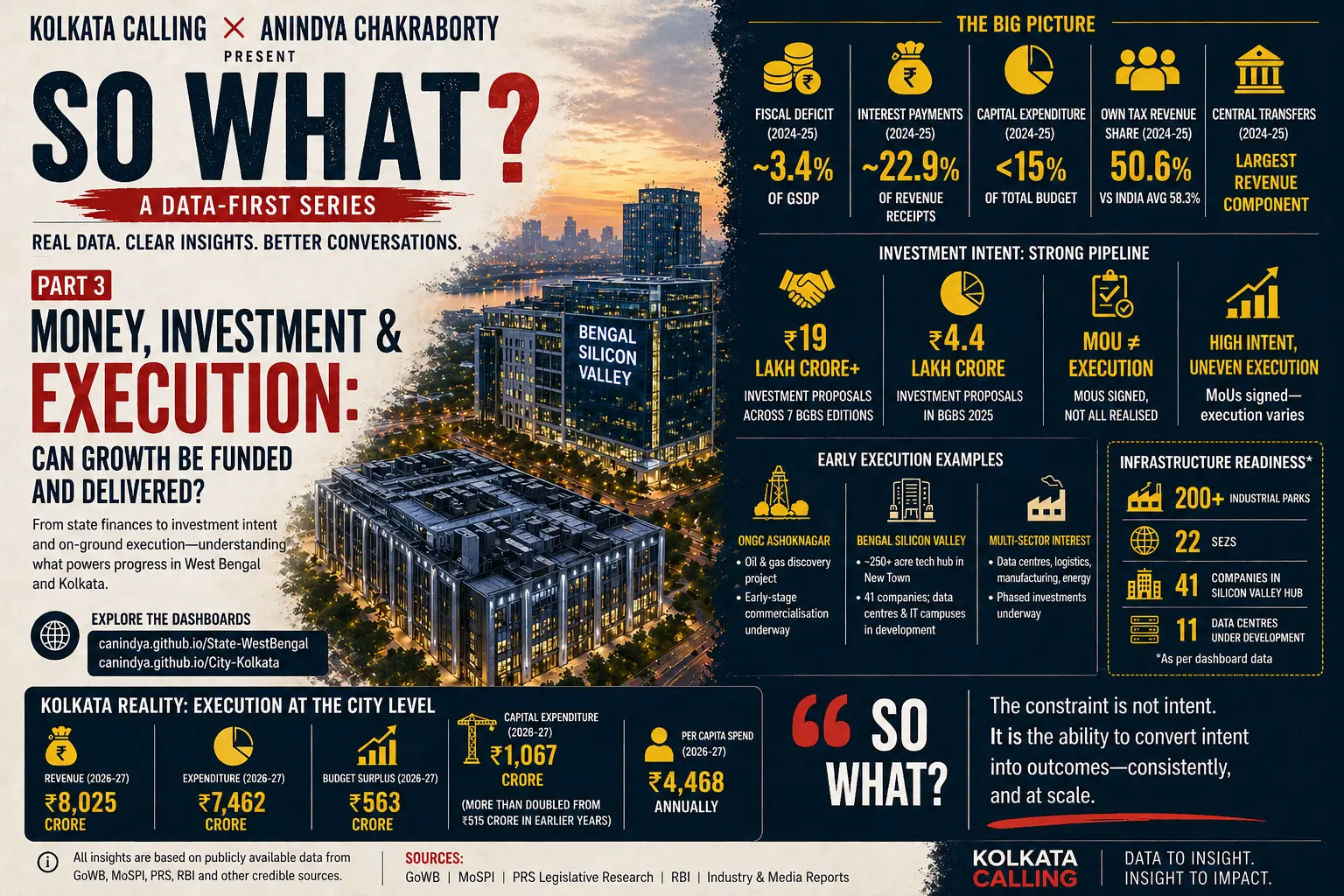
This is Part 3 of “So What?” — a data-first series by Kolkata Calling, built in collaboration with and based on the West Bengal & Kolkata dashboards compiled by Anindya Chakraborty.
In Part 1, we looked at the economy and growth.
In Part 2, we looked at livelihood and jobs.
Both pointed to the same underlying question:
If growth is happening — what determines how far it can go?
The answer lies in something less visible, but more fundamental:
Money — how it is earned, allocated, and converted into outcomes.
The State’s Balance Sheet: Stable, But Constrained
At a headline level, West Bengal’s finances appear stable.
The fiscal deficit stands at around 3.4% of GSDP, broadly aligned with fiscal norms. The debt-to-GSDP ratio, at around 34.5%, remains elevated but is gradually declining as economic growth outpaces borrowing.
But the structure of the budget tells a deeper story.
Expenditure has exceeded revenue every single year, making the deficit structural rather than cyclical.
At the same time, a large share of spending is already committed:
- Interest payments alone account for ~22.9% of revenue receipts
- Welfare, pensions, and salaries absorb a significant portion of expenditure
- Capital expenditure — the kind that builds long-term assets — remains below 15% of the budget
This creates a clear constraint.
The state is spending — but much of that spending is already spoken for.
Revenue: Dependence and Limited Flexibility
Where the money comes from matters just as much as how it is spent.
Central transfers remain the single largest source of revenue, while the state’s own tax share stands at around 50.6% — below the national average of ~58.3%.
This shapes fiscal autonomy.
Growth ambitions exist — but fiscal flexibility is limited.
Investment Story: Strong Intent, Growing Signals
If the budget reflects constraint, the investment story reflects ambition.
Across seven editions of the Bengal Global Business Summit (BGBS), the state has attracted around ₹19 lakh crore in investment proposals, with the latest edition (2025) alone accounting for ₹4.4 lakh crore.
These numbers are significant.
They reflect sustained interest across sectors — including energy, infrastructure, IT, logistics, and manufacturing.
Some of this intent is beginning to translate into real, on-ground activity.
- The ONGC Ashoknagar project is moving toward commercial production after initial investments and exploration phases
- The Bengal Silicon Valley Tech Hub in New Town — spread over ~250 acres — is seeing development of IT campuses, data centres, and digital infrastructure
- Multiple players across data centres, logistics, and services have announced and initiated phased investments
These are not isolated announcements.
They indicate a broader direction.
But Execution Remains the Real Test
At the same time, it is important to distinguish between intent and outcome.
The headline investment numbers represent signed MoUs — not completed projects.
Even where conversion is happening, it is often:
- Phased
- Time-bound
- Dependent on regulatory, financial, and market conditions
This is not unique to West Bengal.
Across India, investment summits generate intent. The real measure of success lies in:
What actually gets built, operationalised, and scaled.
Infrastructure Exists — Conversion Is the Challenge
One of the more interesting insights from the dashboard is that infrastructure availability is not the primary constraint.
West Bengal already has:
- 200+ industrial parks
- 22 SEZs
- 41 companies in the Silicon Valley Hub
- 11 data centres under development
This suggests that the ecosystem — at least in terms of physical readiness — exists.
The constraint lies elsewhere.
Converting proposals into operating businesses, consistently and at scale.
Kolkata: Where Policy Meets Execution
If the state reflects strategy, Kolkata reflects execution.
The Kolkata Municipal Corporation (KMC) budget offers a grounded view of how resources are deployed.
For 2026–27:
- Revenue: ₹8,025 crore
- Expenditure: ₹7,462 crore
- Surplus: ₹563 crore
Unlike the state, the city operates with a balanced budget and surplus.
Capital expenditure has also increased meaningfully over time — more than doubling from ₹515 crore to ₹1,067 crore.
This reflects a growing focus on infrastructure and service delivery.
At the same time, the scale remains limited.
Per capita municipal spending stands at around ₹4,468 annually, highlighting the constraints of urban governance in a large metropolitan system.
A System of Trade-offs
Taken together, the picture that emerges is not one of absence — but of trade-offs.
- Fiscal discipline exists — but limits flexibility
- Investment interest is strong — but execution is gradual
- Infrastructure is available — but utilisation is uneven
- Urban governance is stable — but resource-constrained
None of these are absolute weaknesses.
But they shape the pace of progress.
So What?
This is where the data comes together.
Growth is not just about how much investment is announced.
It is about how consistently that investment is funded, executed, and scaled.
The real takeaway is this:
The constraint is not intent.
It is the ability to convert intent into outcomes — consistently, at scale.
Because ultimately:
- Announcements signal ambition
- Budgets define capacity
- But execution determines outcomes
📊 Explore the full dashboards:
- https://canindya.github.io/State-WestBengal/investment
- https://canindya.github.io/State-WestBengal/budget
- https://canindya.github.io/City-Kolkata/governance
About this Series
Anindya Chakraborty, an IIM Calcutta alumnus and Kolkata-based product and consulting professional, has built publicly accessible dashboards on Kolkata and West Bengal using verified public datasets. This collaboration combines his data layer with Kolkata Calling’s narrative lens — translating complex data into clear, balanced insights.