SO WHAT? Part 2 | Work, Jobs & Livelihoods: Why Growth Doesn’t Always Feel Like It
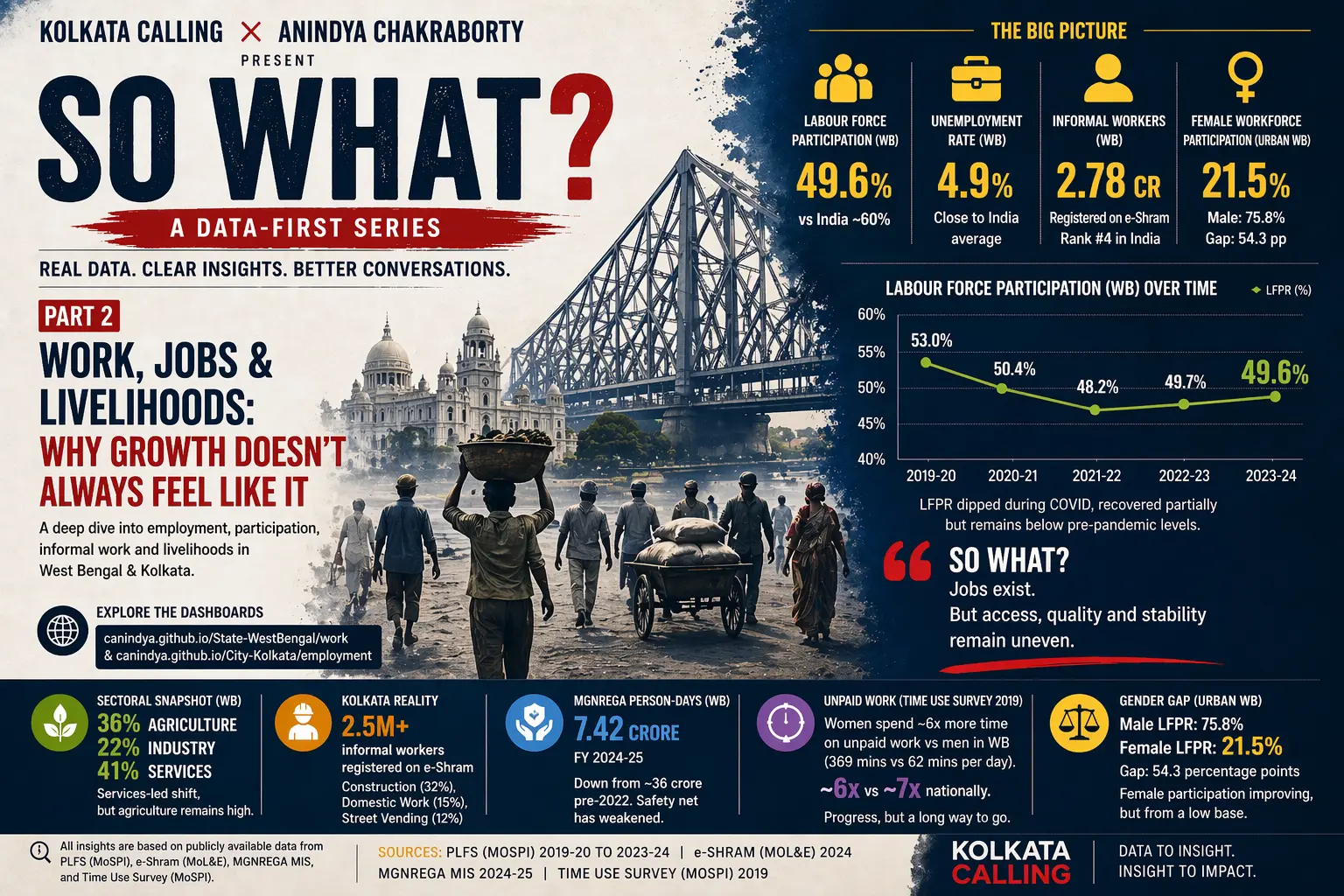
This is Part 2 of “So What?” — a data-first series by Kolkata Calling, built in collaboration with and based on the West Bengal & Kolkata dashboards compiled by Anindya Chakraborty.
In Part 1, we looked at the economy.
The data suggested something nuanced. West Bengal is growing — but not necessarily catching up.
That raises a more immediate and personal question:
If the economy is growing, why doesn’t it always feel like it?
To answer that, we need to shift the lens — from output to work, jobs, and livelihoods.
Who Is Working — And Who Isn’t
At a headline level, West Bengal’s labour market does not appear alarming.
The unemployment rate stands at around 4.9%, broadly in line with national averages. But unemployment, on its own, is only a partial measure.
A more telling indicator is participation.
Only about 49.6% of the population aged 15 and above is part of the labour force, compared to roughly 60% at the national level.
This gap matters.
It suggests that the challenge is not just about job creation — but also about access, participation, and inclusion in the workforce.
The trend over time reinforces this. Labour force participation in West Bengal declined from 53% in 2019–20 to 48.2% during the pandemic, and has only partially recovered to current levels.
The recovery is visible — but incomplete.
The Structure of Employment
Where people work matters as much as how many people work.
In West Bengal, about 41.4% of workers are employed in services, while 36.5% remain in agriculture and about 22% in industry.
Compared to the national picture, the state is more services-oriented and less dependent on agriculture — a pattern shaped by urban centres like Kolkata and industrial corridors such as Howrah and Asansol-Durgapur.
This is a positive shift.
But it is also incomplete.
A large share of the workforce continues to be engaged in sectors that are typically lower in productivity and income stability. The transition is happening — but unevenly.
Kolkata: A Services Economy, With Layers Beneath
In Kolkata, this structural shift is more visible — and more complex.
Labour force participation in urban West Bengal stands at about 48.2%, with unemployment at roughly 6%.
These are not extreme numbers.
But what defines Kolkata’s employment landscape is the nature of work itself.
As the dashboard notes, “the line between formal and informal work was never a line — it was a spectrum.”
More than 2.5 million workers in Kolkata are registered on e-Shram, indicating a substantial informal workforce.
A significant share of this workforce is concentrated in sectors such as construction, domestic work, and street-level services — all essential, but often outside formal protections.
The result is an economy that is active — but layered.
The Informal Backbone
At the state level, this pattern becomes even more pronounced.
Over 2.78 crore workers in West Bengal are registered on e-Shram, making it one of the largest informal workforces in India.
Agriculture alone accounts for more than half of these registrations, followed by construction and domestic services.
This is not a marginal segment.
It is a core part of how the economy functions.
When Safety Nets Weaken
In such a system, safety nets play a critical role.
MGNREGA, which once generated around 36 crore person-days annually, has seen a sharp decline following funding disruptions since 2022.
Current levels stand at around 7.42 crore person-days in 2024–25.
The impact of this is not always visible in headline statistics.
But it is felt in reduced fallback income, increased dependence on informal work, and greater pressure on migration.
The Gender Gap — Progress and Distance
One of the most important — and often overlooked — dimensions of employment is gender.
In urban West Bengal:
- Male labour force participation stands at 75.8%
- Female participation stands at 21.5%
This is a gap of over 50 percentage points, one of the widest among major urban regions.
At the same time, there are signs of gradual improvement. Female participation has increased over time — though from a low base.
The story becomes more nuanced when we look at unpaid work.
Women in West Bengal spend, on average, 369 minutes per day (over 6 hours) on unpaid domestic and caregiving work, compared to 62 minutes for men — roughly 6 times higher.
At the national level, the gap is even wider — with women spending about 298 minutes compared to 43 minutes for men, a ratio of roughly 6.9 times.
This comparison is important.
It shows that while the imbalance remains significant, West Bengal is not an outlier — and in relative terms, performs slightly better than the national average on this dimension.
However, the larger point remains unchanged.
A substantial portion of work — particularly by women — remains unpaid, uncounted, and outside formal economic metrics, even though it sustains households and enables the rest of the economy to function.
So What Does This Tell Us?
Taken together, the data presents a layered picture.
West Bengal’s employment story is not defined by high unemployment.
It is defined by:
- Participation levels that remain below national averages
- A large and persistent informal workforce
- Sectoral shifts that are incomplete
- Reduced safety nets in rural areas
- And a gender gap that, while improving, remains significant
So What?
This is where the data moves from description to insight.
The issue is not just whether jobs exist.
It is what kind of jobs exist — and who they reach.
The real takeaway is this:
Growth without participation and productivity does not translate into broad-based economic progress.
And that is the gap this series is trying to understand.
📊 Explore the dashboards:
1. https://canindya.github.io/State-WestBengal/work
2. https://canindya.github.io/City-Kolkata/employment
About this Series
Anindya Chakraborty, an IIM Calcutta alumnus and Kolkata-based product and consulting professional, has built publicly accessible dashboards on Kolkata and West Bengal using verified public datasets. This collaboration combines his data layer with Kolkata Calling’s narrative lens — translating complex data into clear, balanced insights.