SO WHAT? - Part 1: West Bengal’s Economy: Growing, But Not Catching Up
This is Part 1 of “So What?” — a data-first series by Kolkata Calling, built in collaboration with and based on the West Bengal & Kolkata dashboards compiled by Anindya Chakraborty.
There are two competing stories about West Bengal’s economy.
One suggests the state has fallen behind, weighed down by structural challenges and missed opportunities. The other argues that growth is steady, resilience is visible, and the narrative of decline is overstated.
Both perspectives contain elements of truth. But neither, on its own, captures the full picture.
To move beyond opinion, we turned to a comprehensive public dashboard built by Anindya Chakraborty — a Kolkata-based product and consulting professional, who has brought together a wide range of official datasets into a single, transparent, and source-linked view of the state’s economy.
The analysis that follows is grounded entirely in publicly available data, including sources such as MoSPI, RBI, NITI Aayog, GST Council, and the Udyam Portal, as compiled in the dashboard.
A Story of Growth — At First Glance
Start with the headline number, and the picture looks encouraging.
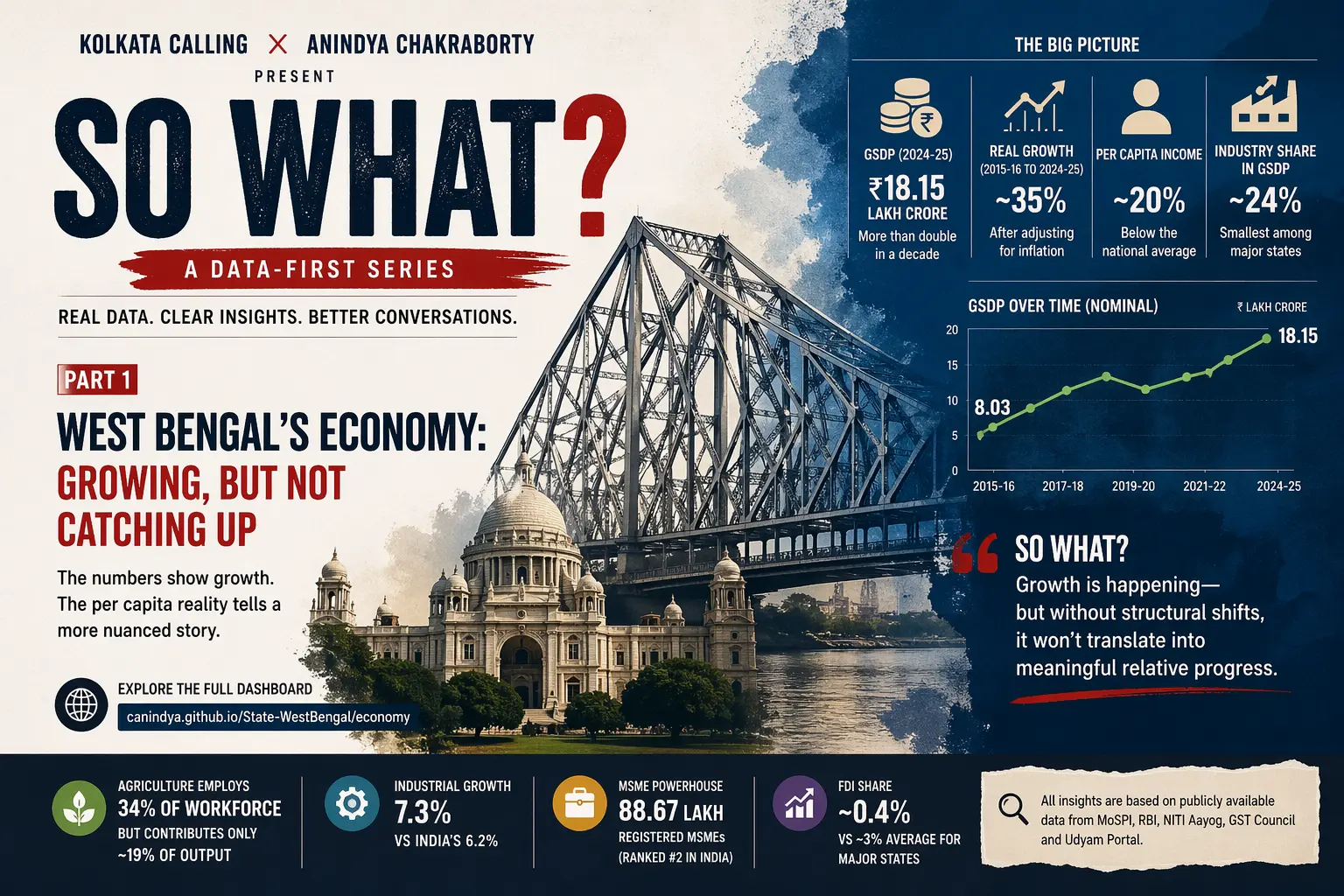
West Bengal’s Gross State Domestic Product (GSDP) has more than doubled over the past decade — rising from ₹8.03 lakh crore in 2015–16 to ₹18.15 lakh crore in 2024–25, making it the 6th largest state economy in India.
Even the economic shock of the COVID-19 period appears relatively shallow, followed by a strong recovery.
At a glance, this reflects a familiar pattern: resilience during crisis, followed by steady expansion.
But headline numbers, by themselves, rarely tell the complete story.
When Growth Isn’t the Whole Story
A deeper look reveals an important distinction — the difference between nominal growth and real growth.
While the total size of the economy has nearly doubled, the increase in real output — after adjusting for inflation — is significantly lower, at around 35% over a comparable period.
In practical terms, a substantial portion of the headline growth reflects rising prices rather than a proportional increase in goods and services produced.
This does not negate the growth story. But it does change how we interpret it.
The Per Capita Reality
The next layer of the story is more revealing — and more sobering.
The dashboard presents two related indicators. One shows per capita income at approximately ₹2.03 lakh, around 20% below the national average. Another places per-capita NSDP at ₹1.63 lakh for 2024–25, compared to a major-state average of ₹2.35 lakh.
More importantly, West Bengal’s relative position has remained largely unchanged. For over a decade, the state has consistently ranked in the lower-middle tier — around #12 to #14 among major states.
What this suggests is subtle but important.
The economy is growing in absolute terms — partly because it is large. But the average resident is not significantly gaining ground relative to peers in faster-growing states.
Growth, in other words, is not translating into convergence.
The Structure of the Economy
To understand why, we need to look at how the economy is structured.
Services account for around 55% of GSDP, while industry remains the smallest component.
This imbalance becomes more meaningful when we look at employment.
Roughly 34% of the workforce is engaged in agriculture, even though the sector contributes only about 19% of total output.
A similar, though smaller, gap exists in manufacturing — employing roughly 19% of workers while contributing about 14% of output — while services generate a disproportionately higher share of economic value relative to employment.
This gap between where people work and where value is generated highlights a structural challenge: a large share of the workforce remains in relatively low-productivity sectors.
Industry: Encouraging Momentum, But Limited by Scale
If there is one area where the data offers cautious optimism, it is industry.
Industrial growth in West Bengal has recently outpaced the national average — with the state recording around 7.3% growth compared to India’s 6.2%.
However, scale remains a constraint.
Despite strong growth rates, West Bengal accounts for less than 6% of India’s organised manufacturing output, and sits outside the top five industrial states.
What We Are Seeing on the Ground
Over the past year, Kolkata Calling has tracked a steady stream of companies, sectors, and investment activity across Kolkata and West Bengal.
What stands out is not just isolated announcements — but a pattern across multiple sectors.
🏢 Office Market & GCC Expansion
Kolkata’s office market has seen one of its strongest phases in recent years.
- Office leasing grew 69% YoY in 2025, the highest among major Indian cities
- GCC leasing surged 239% YoY, contributing 30% of total office absorption. Visteon and SEI open new GCCs.
👉 Kolkata Emerges as India’s Fastest-Growing Office Market
👉 GCC Leasing in Kolkata Surges 239% YoY
👉 US Fintech Major SEI Opens New Global Capability Centre in Kolkata
👉 Kolkata & the GCC Comeback Story: Inside Visteon's new GCC in Kolkata
These trends point to increasing global interest — driven by talent and cost advantages — but from a relatively small base.
💻 IT, Analytics & Company Expansion
There is also visible movement at the company level.
- Firms like Embee Software, QA, Publicis Sapient, LTIMindtree, KPMG, Global Foundries, Tredence, Linde expanded their presence in Kolkata.
- Global players are exploring AI-led and digital transformation initiatives in Bengal
👉 Embee Software Launches 10,000 Sq Ft Office in Kolkata
👉 Publicis Sapient Eyes Bengal Startups for AI Transformation
👉 Tredence Inc. Expands Its Footprint in Kolkata with a New 400-Seater Office in Sector V
👉 London-Based QA Ltd Enters Kolkata, Sets Up Office at Godrej Genesis
👉 KPMG Global Services Inaugurates 46,000 Sq. Ft. Office at Godrej Waterside, Salt Lake Sector V
👉 Signal:
Growth is happening — particularly in IT, analytics, and services — but still at a mid-scale ecosystem level.
🏗 Real Estate & Urban Expansion
Real estate activity reinforces this broader trend.
- Office leasing rose 65% YoY in Q3 2025
- Residential launches increased 56% YoY
- Growth concentrated in New Town and peripheral corridors
👉 Kolkata Real Estate Sector Records Strong Growth
👉 Signal:
Growth is visible — but geographically concentrated, not evenly distributed.
🚗 Urban Services & Mobility
New-age urban services are also expanding.
- Cityflo launched 200 app-based buses in Kolkata, connecting residential hubs to business districts
👉 Cityflo Enters Kolkata with 200 Buses
👉 Signal:
Urban demand is evolving alongside economic activity.
The MSME Backbone
Another critical pillar of the state’s economy is its MSME base.
West Bengal has over 88.67 lakh registered MSMEs, ranking second in India by count.
Public data suggests that a significant share of these enterprises are concentrated in services and trading, followed by manufacturing.
This distribution matters.
It reflects strong entrepreneurial activity — but also highlights the dominance of small-scale, lower-value segments.
The long-term impact will depend on whether these businesses can scale and move up the value chain.
Beyond Perception: What the Data Gets Right
Not all indicators align with pessimistic narratives.
- Poverty rate: 11.89% vs India’s 14.96%
- Unemployment: ~6% (mid-range among states)
These are meaningful indicators of relative stability.
The Constraints That Persist
At the same time, structural constraints remain.
- Kolkata handles around 51 daily international flights, vs 500+ in major metros
- FDI share: ~0.4% vs ~3% average for major states
These gaps reflect limitations in:
- connectivity
- capital inflow
- scale of economic integration
So What?
Taken together, the data does not support extreme conclusions.
West Bengal is not an economy in decline. It is growing, recovering, and showing real activity across multiple sectors.
But it is also not an economy that is rapidly catching up.
The deeper challenge is structural.
Growth is happening — but much of it is:
- incremental
- service-led
- and constrained by scale
The real takeaway is this:
Growth is happening — but it is not yet translating into meaningful relative progress.
That is the gap this series will explore.
Because the question is no longer whether West Bengal is growing.
It is whether it can change how it grows.
📊 Explore the full dashboard:
https://canindya.github.io/State-WestBengal/economy
About this Series
Anindya Chakraborty, an IIM Calcutta alumnus and Kolkata-based product and consulting professional, has built publicly accessible dashboards on Kolkata and West Bengal using verified public datasets. This collaboration combines his data layer with Kolkata Calling’s narrative lens — translating complex data into clear, balanced insights.