Kolkata: The Unlikely Case for India's Most Livable Megacity
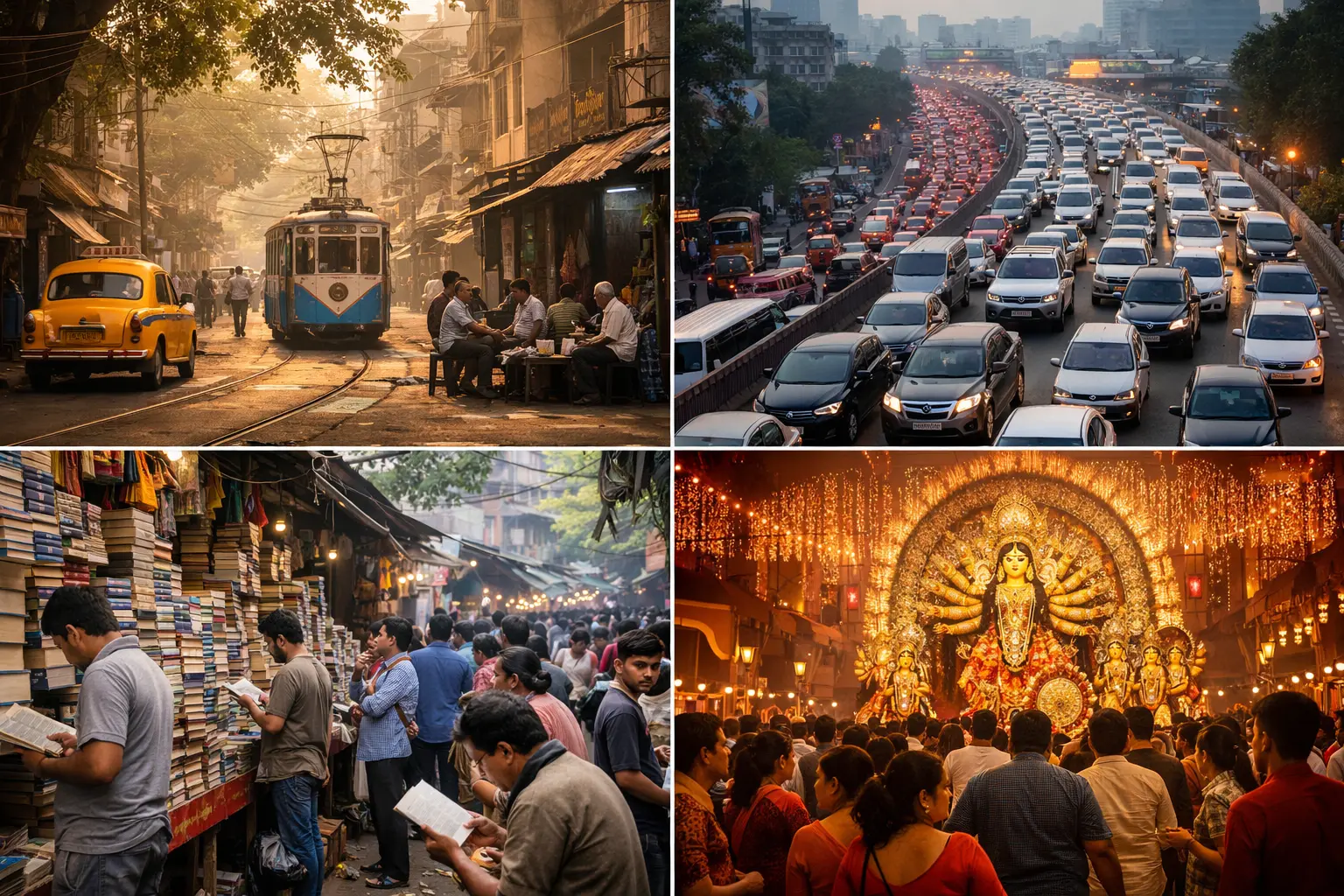
For decades, Kolkata has been part of a familiar narrative.
A city that peaked too early.
A city that lost its edge.
A city people left behind.
And yet, quietly and without much noise, Kolkata may have done something that many of India’s fastest-growing cities have not.
It has remained livable.
When we speak about cities like Mumbai, Bengaluru or Delhi, the conversation is usually about growth—about jobs, capital, infrastructure, and global ambition. These are cities that move fast, expand rapidly, and constantly reinvent themselves.
But that speed comes at a cost.
Housing becomes unaffordable. Commutes stretch into hours. Daily life turns into a negotiation between time, money, and stress.
Kolkata, for all its perceived economic lag, has largely resisted that trade-off.
In Kolkata, the idea of living in the city has not yet become a financial burden for the majority. A middle-class household can still aspire to own or rent a home without stretching itself to breaking point. The cost of everyday life—food, transport, basic services—remains within reach in a way that feels increasingly rare in urban India.
This is not just about affordability. It is about dignity.
Because a city is not defined only by how much you can earn, but by how comfortably you can live.
Then there is the question of time.
In many Indian megacities, time is the first casualty of growth. Hours are lost in traffic, in long commutes, in simply moving from one part of the city to another. Over time, this erodes not just productivity, but also quality of life.
Kolkata, despite its density and ageing infrastructure, still operates at a more human scale. Distances feel manageable. Public transport, though imperfect, remains functional and widely used. There are still neighbourhoods where life happens within a few kilometres.
It is a city that, in many ways, still respects your time.
But perhaps Kolkata’s most underestimated strength is not physical—it is social.
There is a certain cohesion here that is difficult to quantify but easy to feel. Families often remain connected across generations. Neighbourhoods retain a sense of familiarity. Conversations still matter.
In an era where cities are becoming increasingly transactional, Kolkata continues to offer something more rooted—a sense of belonging.
And then there is culture.
In many modern cities, culture is curated, packaged, and consumed occasionally. In Kolkata, it is woven into everyday life. It exists in conversations, in books, in theatre, in music, in festivals that feel less like events and more like collective experiences.
This cultural depth does not just define the city’s identity; it shapes the way people experience life within it.
None of this is to suggest that Kolkata has no challenges.
It does.
The pace of job creation has not kept up with its peers. Private investment has been uneven. Many young professionals still feel the need to leave in search of better opportunities. Parts of the city’s infrastructure need significant renewal.
There is a real risk that Kolkata could become a city that is comfortable, but limited.
And yet, that is precisely where the opportunity lies.
Because Kolkata is not starting from zero. It already has what many cities are now trying to rebuild—affordability, social cohesion, cultural richness, and a relatively balanced pace of life.
If it can now layer this with sustained economic growth—through new industries, better infrastructure, and stronger job creation—it does not need to imitate any other city.
It can define its own model.
In a world that is beginning to question the cost of unchecked urban growth, Kolkata’s trajectory suddenly looks less like a failure and more like an alternative.
Not the fastest city.
Not the richest.
But possibly one of the most livable.
And if the next decade is played right, that may turn out to be its greatest advantage.