WB Budget 2026–27: The Long Game Beneath the Headlines
Much of the early coverage of West Bengal’s Interim Budget for 2026–27 focused on welfare measures and cash transfers. Those announcements matter, especially from a social protection lens. But they are only one part of the story.
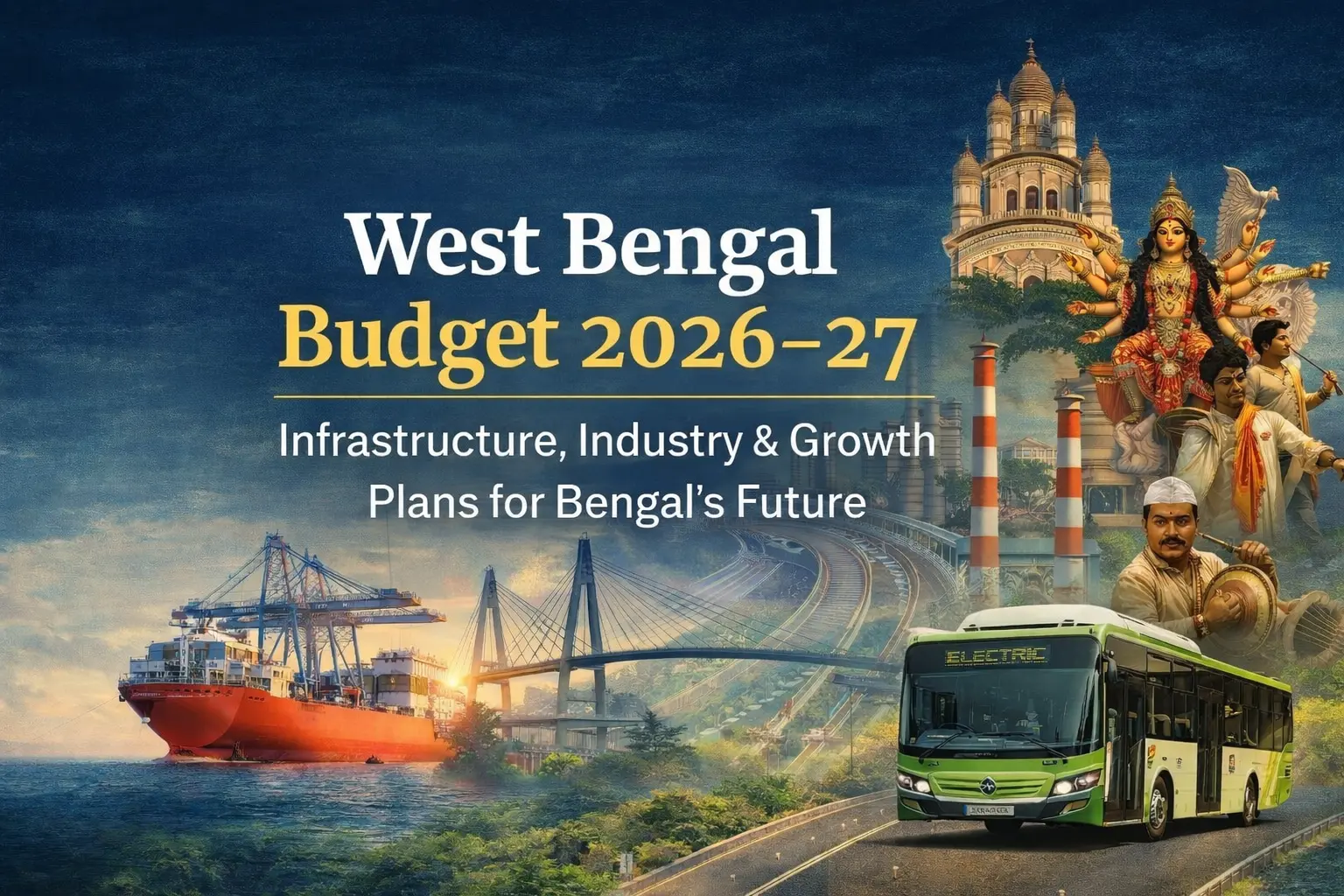
Read carefully, the budget speech outlines something more structural: a medium-term blueprint aimed at infrastructure-led growth, industrial expansion, modern cities, and a culture-driven economic strategy. This article looks past the headlines to focus on the plans that can tangibly shape Bengal’s growth over the next decade.
Industrial corridors and MSMEs: building the growth backbone
At the heart of the budget is a clear emphasis on industrial corridors as engines of manufacturing and logistics growth. Six Industrial and Economic Corridors are proposed as integrated ecosystems, designed to attract private investment, improve freight movement, and generate large-scale employment.
This is complemented by a strong MSME push. West Bengal already has one of the largest MSME bases in the country, and the budget builds on this by announcing five new MSE Industrial Parks across Jalpaiguri, Birbhum, Bankura and Murshidabad. The objective is straightforward: decentralise industrial growth, reduce regional imbalance, and bring jobs closer to districts.
A proposed Global Trade Centre, to be developed on government land through collaboration, further signals the intent to connect Bengal’s manufacturers and exporters more directly with national and global markets.
Ports, roads and flood control: hard infrastructure with long-term returns
One of the most consequential announcements is the Tajpur Deep Sea Port, notified as a non-major port and positioned as a strategic maritime gateway for the state. A functioning deep sea port has multiplier effects: it reshapes export competitiveness, industrial location choices, and logistics economics across sectors.
Road and bridge construction continues at scale, with extensive investments in rural roads, arterial corridors, flyovers and bypasses. The emphasis is not just on connectivity, but on cutting travel time, improving logistics efficiency, and linking industrial, urban and tourism hubs.
Equally significant is the Ghatal Master Plan, aimed at providing a permanent solution to chronic flooding in large parts of West Midnapore and surrounding districts. Flood mitigation may not grab headlines, but it is foundational for economic stability, agricultural productivity and climate resilience.
Power and clean energy: enabling industry and future cities
The budget reinforces West Bengal’s transition from power deficit to power surplus, while preparing for future demand. Planned additions include major thermal capacity at Salboni, alongside battery energy storage systems at Durgapur and Goaltore to manage peak loads.
On the clean energy front, the state continues to expand solar capacity through ground-mounted, floating and rooftop projects. Reliable power, storage and grid stability are not just energy goals—they are prerequisites for manufacturing, data infrastructure, urban expansion and large commercial developments.
The budget also nudges the transport sector towards cleaner mobility, with electric buses planned for key urban regions.
Modern cities mission: upgrading urban Bengal, not just Kolkata
One of the most forward-looking proposals is the plan to transform a wide network of towns and cities into “modern cities”—business-friendly, employment-oriented and digitally enabled.
From Siliguri and Durgapur to Kalyani, Bolpur, Cooch Behar and Digha, the aim is to upgrade urban infrastructure, services and investment readiness across the state. A dedicated committee and survey process has been announced, with a comprehensive report expected by the end of 2026.
If executed well, this could mark a decisive shift from Kolkata-centric growth to distributed urban development, unlocking new industrial, commercial and talent hubs across Bengal.
Culture and tourism: from identity to economic engine
The budget treats culture not just as heritage, but as a livelihood and growth sector. Tourism is positioned as a major economic driver, supported by destination development across the hills, coast, Sundarbans, heritage towns and pilgrimage circuits.
There is also a clear push to strengthen Bengal’s position in the MICE economy (meetings, conferences, exhibitions), supported by a growing pipeline of premium hotels and convention infrastructure.
Support for folk artists, cultural institutions, theatres, museums and festivals continues, but with a stronger framing around sustainability and employment. The proposed development of a Cultural City at Baruipur, anchored around the Tele Academy, reflects an effort to institutionalise creative infrastructure at scale.
Beyond populism: what the budget is really signalling
Welfare measures will always dominate election-season headlines. But the budget speech itself tells a broader story—one focused on corridors, ports, power, cities and culture as long-term growth levers.
The real test now is execution. If these plans move from announcements to on-ground delivery, West Bengal could strengthen its industrial competitiveness, modernise its cities, improve climate resilience, and convert its cultural capital into sustainable economic value.
For businesses, investors, and citizens alike, these are the signals that matter most.